How does jealousy affect mental health?
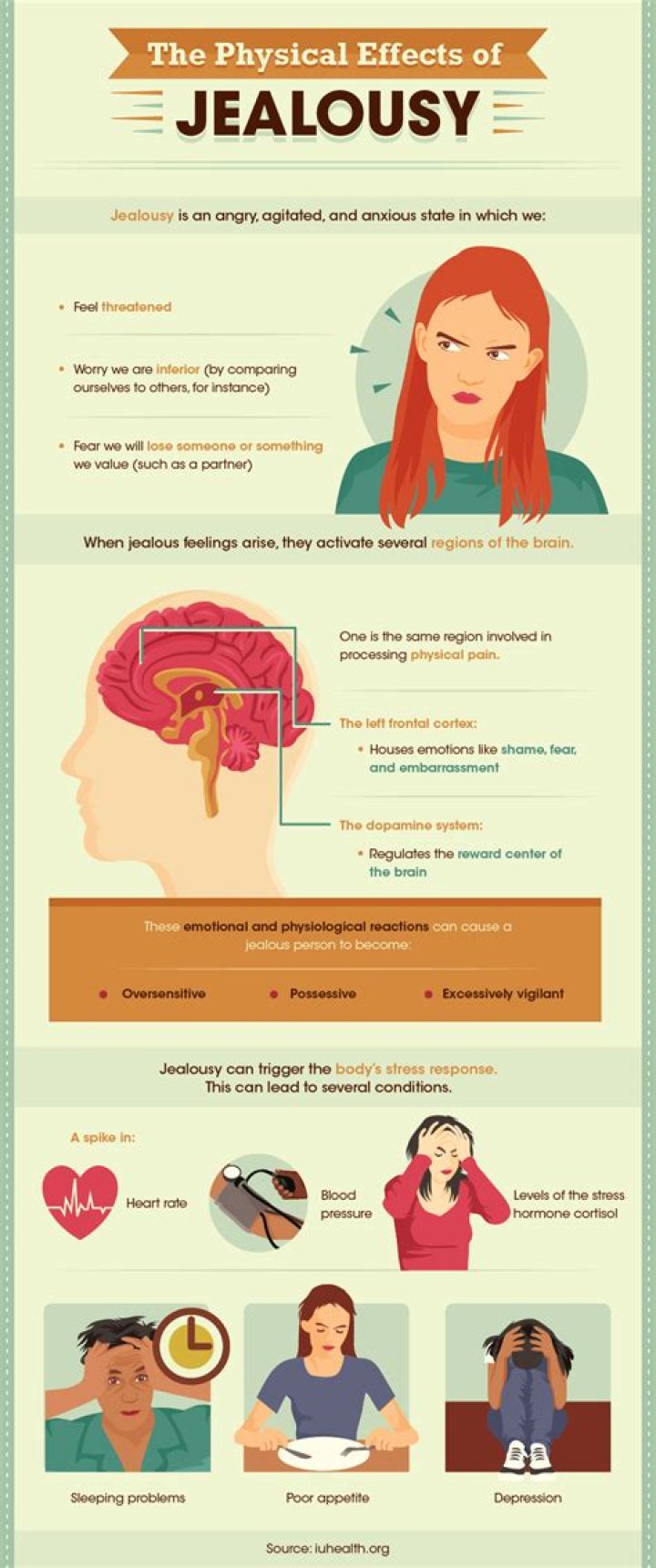
Just about everyone feels jealous or envious once in a while. However, when these emotions start to become overwhelming, it can trigger concerns about inadequacy or feeling ill will toward others. It can also bring about symptoms of stress. In some cases, it can lead to depression in some cases.
How does jealousy affect the brain?
Summary: Jealousy increases activity in the cingulate cortex and lateral septum, areas of the brain associated with social pain and pair bonding, researchers report.What can jealousy do to a person?
Everyone experiences jealousy at some point in their lives, but the emotion can become unhealthy and negatively impact your relationships. It can range in intensity. When it's severe, irrational jealousy can lead to distrust, paranoia, abuse, or even physical violence.Can jealousy turn into anxiety?
Jealousy can make you feel angry, anxious and threatened. You might become oversensitive and possessive.Is jealousy a symptom of depression?
Some telltale signs that you may be experiencing envy that is affecting your depression or anxiety can include: Frequent comparisons between your life and others' lives. Experiencing frustration, jealousy or feelings of inadequacy when good things happen to other people.How Jealousy Distorts Your Thinking
What is the root of jealousy?
Research has identified many root causes of extreme jealousy, including low self-esteem, high neuroticism, and feeling possessive of others, particularly romantic partners. Fear of abandonment is also a key motivator.What triggers jealousy?
Understand your triggersJealousy may be driven by low self-esteem or a poor self-image. If you don't feel attractive and confident, it can be hard to truly believe that your partner loves and values you. Other times, jealousy can be caused by unrealistic expectations about the relationship.
Why jealousy is toxic?
Jealousy, at its core, is a byproduct of fear, fear of not being good enough, fear of loss. When it hits, it can trick us into believing our relationship is in immediate danger, making it impossible to distinguish between natural feelings of protectiveness and irrational suspicion.What are the physical symptoms of jealousy?
“Your amygdala, which manages your emotions—fear, anger and sadness, to name a few—will kick into high gear and you may experience physical pain.” Hall says that intense jealousy can lead to: Stomach aches. Weight gain or loss. Headaches or migraines.Is jealousy a toxic trait?
Jealousy becomes toxic for relationships, however, if left unchecked, Freeman adds. Trust is a key component of any healthy, successful relationship. Jealousy breeds suspicion, doubt, and mistrust, which can snowball into pretty intense emotions and behaviors, he says.Is jealousy a mental illness?
Morbid jealousy is not a psychiatric disorder, but a syndrome that occurs in many psychiatric conditions.What is unhealthy jealousy?
Unhealthy jealousy is rooted in fear of abandonment and a worry about not being truly loved. 1 Unhealthy jealousy is characterized by: Being paranoid about what a partner is doing or feeling. Demanding an account of where a partner has been. Displaying unusual insecurity and fear.What are three types of jealousy?
Consistent with this definition, Buunk (1997) distinguished between three qualitatively different types of jealousy: reactive, anxious and preventive jealousy.What chemical is released when you are jealous?
A new study carried out at the University of Haifa has found that the hormone oxytocin, the "love hormone," which affects behaviors such as trust, empathy and generosity, also affects opposite behaviors, such as jealousy and gloating.How do I get rid of jealousy?
Here's a look at some ways to cope with jealousy and examine what's at the root of your feelings.
- Trace it back to its source. ...
- Voice your concerns. ...
- Talk to a trusted friend. ...
- Put a different spin on jealousy. ...
- Consider the full picture. ...
- Practice gratitude for what you have. ...
- Practice in-the-moment coping techniques.
Is jealousy natural or learned?
According to evolutionary psychologists, the answer to all these questions is no. Jealousy is part of our nature, found in people all over the world.Why jealousy is a red flag?
In a weird way, jealousy can be used as a “red flag” to “encourage you to do a little self-exploration.” That is, if you can acknowledge it before it becomes toxic to your relationship. Degges-White says, "Simply put, jealousy is motivated by fear.What is a healthy level of jealousy?
“Mild jealousy can be healthy,” says Dr. Magavi. “It reiterates the fact that an individual cares about his or her partner, values them and does not want to lose them.” We may become jealous of the attention our partners give to others because we want to be the only apple of their eye.Why is jealousy so destructive?
Jealousy can rear its head in any relationship. It's a destructive emotion: it has the potential to suffocate a happy partnership and break down the trust that was there. Jealousy can cause you to experience a range of feelings, from insecurity and suspicion to rejection, fear, anger or anxiety.Why is jealousy such a powerful emotion?
Feelings of jealously motivate consumers to buy things that are more likely to recapture the attention of their partners. 'Jealousy plays a positive role in social bonding, by signaling that a relationship may need attention, and it may be particularly important for keeping a couple together.What are the two types of jealousy?
Jealousy comes in two very common forms: reactive jealousy and suspicious jealousy.What God says about being jealous?
Proverbs 27:4 tells us, “Anger is cruel, and wrath is like a flood, but jealousy is even more dangerous.”Why am I such a jealous person?
Jealousy in a relationship often stems from insecurity and a fear that your partner might reject you. You can end up projecting your worries and fears onto the other person and that's not healthy in any relationship. It might be that your worries are based on childhood memories of your parents' relationship.Is jealousy inherited?
Jealousy was 29% heritable, and non-shared environmental influences explained the remaining variance. The magnitude and sources of genetic influences did not differ between the sexes.What are the four stages of jealousy?
What are the stages of jealousy
- Stage 1: Identification. Jealousy is a three- part emotion in which the patient and two other parities are involved. ...
- Stage 2: Confrontative. ...
- Stage 3: Redirecting. ...
- Stage 4: Medea.