How quickly does a mole change into melanoma?
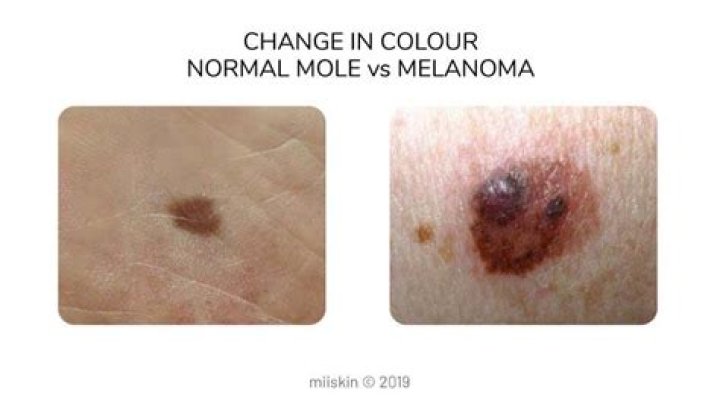
Melanoma can grow very quickly. It can become life-threatening in as little as 6 weeks and, if untreated, it can spread to other parts of the body. Melanoma can appear on skin not normally exposed to the sun. Nodular melanoma is a highly dangerous form of melanoma that looks different from common melanomas.
Can a mole suddenly become cancerous?
Can a Non-Malignant Mole Become Cancerous? The short answer is yes. For adults, new moles and sudden changes to existing moles can be a sign of melanoma.Can you have a cancerous mole for years?
They can change or even disappear over the years, and very rarely can become skin cancers. Some research suggests that having more than 50 common moles may increase one's risk of melanoma. More worrisome are so-called atypical moles. They often appear during puberty but can pop up throughout life.How long can you have melanoma without knowing?
How long can you have melanoma and not know it? It depends on the type of melanoma. For example, nodular melanoma grows rapidly over a matter of weeks, while a radial melanoma can slowly spread over the span of a decade. Like a cavity, a melanoma may grow for years before producing any significant symptoms.What does early signs of melanoma look like?
What to look for: Usually, the most obvious warning signs of early stage melanoma are changes to your moles or spots: in size, shape, colour or in how they look or how they feel. Melanoma can also appear as a new mole (more commonly in people aged 50 years or more)2.I was Diagnosed with Skin Cancer. (Melanoma)
Do melanomas grow quickly?
Melanoma can grow very quickly. It can become life-threatening in as little as 6 weeks and, if untreated, it can spread to other parts of the body. Melanoma can appear on skin not normally exposed to the sun. Nodular melanoma is a highly dangerous form of melanoma that looks different from common melanomas.Can melanoma just appear suddenly?
Melanoma may suddenly appear without warning, but can also develop from or near an existing mole. It can occur anywhere on the body, but is most common on the upper back, torso, lower legs, head, and neck.What can be mistaken for melanoma?
Top 5 Conditions Often Mistaken For Skin Cancer
- Psoriasis. Psoriasis is a skin condition that is believed to be related to an immune system problem, which causes T cells to attack healthy skin cells by accident. ...
- Seborrheic Keratoses (Benign tumour) ...
- Sebaceous hyperplasia. ...
- Nevus (mole) ...
- Cherry angioma.
Is melanoma raised or flat?
The most common type of melanoma usually appears as a flat or barely raised lesion with irregular edges and different colours. Fifty per cent of these melanomas occur in preexisting moles.Is Stage 1 melanoma serious?
Stage 1 is considered a 'thin melanoma'. If your melanoma is caught before it is too thick the prognosis is very good. Nearly 19 in 20 people who have a stage 1 melanoma are alive at least five years after being diagnosed. Stage 1 is the least serious type of melanoma.Can a doctor tell if a mole is cancerous just by looking at it?
A visual check of your skin only finds moles that may be cancer. It can't tell you for sure that you have it. The only way to diagnose the condition is with a test called a biopsy. If your doctor thinks a mole is a problem, they will give you a shot of numbing medicine, then scrape off as much of the mole as possible.Does melanoma grow slowly?
It might slowly get bigger over several years and might change shape or colour. If it becomes a lentigo maligna melanoma, it starts to grow down into the deeper layers of the skin and may form lumps (nodules).Does melanoma show up in blood work?
Blood tests. Blood tests aren't used to diagnose melanoma, but some tests may be done before or during treatment, especially for more advanced melanomas. Doctors often test blood for levels of a substance called lactate dehydrogenase (LDH) before treatment.What are the 5 warning signs of melanoma?
The "ABCDE" rule is helpful in remembering the warning signs of melanoma:
- Asymmetry. The shape of one-half of the mole does not match the other.
- Border. The edges are ragged, notched, uneven, or blurred.
- Color. Shades of black, brown, and tan may be present. ...
- Diameter. ...
- Evolving.