Is Cepillarse reflexive?
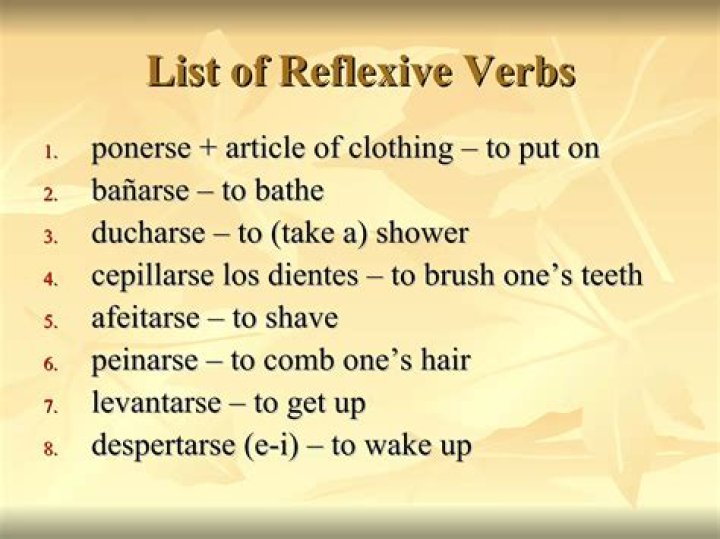
Cepillarse is a reflexive verb. This means that the action is carried out by and for ourselves. When conjugating a reflexive verb in Spanish, we need to add the reflexive pronouns IN FRONT of every conjugated form. These pronouns are (in subject order): me/te/se/nos/os/se.
Is I brush my teeth reflexive?
Reflexive verbs often have to do with personal hygiene, grooming, and dressing: peinarse- to brush one's hair. maquillarse- to make-up oneself. cepillarse (los dientes)- to brush one's teeth.How do you conjugate the reflexive cepillarse?
cepillarse
- me cepillo.
- te cepillas.
- él/ella/Ud. se cepilla.
- nos cepillamos.
- os cepilláis.
- ellos/ellas/Uds. se cepillan.
How do you know if a word is reflexive?
A reflexive verb is one where the subject and object are the same, and where the action 'reflects back' on the subject. It is used with a reflexive pronoun such as myself, yourself and herself in English, for example,I washed myself.; He shaved himself.What are 10 reflexive verbs?
Here's a list of some of the most common reflexive verbs in Spanish:
- Irse (to leave)
- Acordarse (to remember)
- Olvidarse (to forget)
- Sentirse (to feel)
- Darse (to give oneself)
- Encontrarse (to find oneself)
- Preocuparse (to worry)
- Fijarse (to take notice)
Reflexive Verben auf Spanisch lernen
Is Imaginar reflexive?
Imaginar is used just as often as the reflexive form imaginarse. The difference in meaning is really subtle, but conveniently quite similar to the difference between 'imagine' and 'imagine yourself' in English. Also note, this verb is often used as a command.What is a non reflexive verb?
Non-reflexive verbs express that an action is performed by a subject and received by a different object. Its endings are: '-ar', '-er' and '-ir'.What are the 7 reflexive pronouns?
Grammar explanation. Reflexive pronouns are words like myself, yourself, himself, herself, itself, ourselves, yourselves and themselves.What are the 10 examples of reflexive pronoun?
32 Reflexive Pronoun Examples
- myself.
- yourself.
- himself.
- herself.
- oneself.
- itself.
- ourselves.
- yourselves.
What is a reflexive verb in Spanish?
Reflexive verbs are a type of pronominal verb, which means they include or relate to a pronoun. In Spanish, the reflexive pronouns (or pronombres reflexivos) “me, te, se, nos, os” are used in the same way. me. myself.Is Pinta a reflexive verb?
Pintarse (to reflexive of pintar) conjugation.What do reflexive verbs mean?
A reflexive verb is a transitive verb whose subject and object always refer to the same person or thing, so the object is always a reflexive pronoun. An example is 'to enjoy yourself,' as in 'Did you enjoy yourself?' 'reflexive verb' English. Grammar.Is Brosser reflexive?
The French verb brosser means "to brush." To say "I brush my teeth" or "She is brushing her hair," you would use the reflexive se brosser. (Je me brosse les dents and Elle se brosse les cheveux.) Brosser is a regular -er verb.Is Hago a reflexive verb?
Verbs that are only reflexive when they mean “self”| I look at myself in the mirror and I don't like what I see. Ex: Me hago una paella para el almuerzo. | I make myself a paella for lunch.
Is Yo lavo a reflexive verb?
Reflexive Verbs. Definition: a reflexive verb is one in which the subject of the verb does something to itself. For example: I wash the car / lavo el coche (non-reflexive); I wash myself / yo me lavo (reflexive).What are the 5 reflexive pronouns in Spanish?
The 5 Reflexive Pronouns Used With Verbs
- me — myself — Me lavo. ...
- te — yourself (informal) — ¿Te odias? (Do you hate yourself?) ...
- se — himself, herself, itself, themselves, yourself (formal), yourselves (formal), each other — Roberto se adora. ...
- nos — ourselves, each other — Nos respetamos.